


In this article, we’ll explore some key findings from research about the intriguing aspects of the Chinese Language and Mandarin in particular. Read on to find out more.
Table of Contents
- 1. The Chinese Language is better conceptualised as a group of languages, rather than a monolithic concept of a single language with varieties.
- 2. Mandarin is but one Chinese Language, with its own group of varieties.
- 3. Mandarin as one Chinese Language continues to absorb features from other Chinese languages.
- 4. The understanding and use of the Chinese Language are deeply linked to the Chinese culture.
- 5. The syllable is usually the starting point for the analysis of pronunciation in a Chinese Language, including Mandarin.
- 6. In analysing a syllable, chinese linguists prefer the use of initials, finals and tones in the phonemic inventory for any Chinese Language, instead of consonants and vowels.
- 7. Particularly for the Chinese Language of Standard Mandarin, most words are monosyllabic and bisyllabic while containing one or two morphemes.
- 8. Homophony is a common phenomenon in Mandarin.
- 9. Mandarin (or any Chinese Language) lacks inflectional properties – but there is inflection.
- 10. Segmentation of words and parts of speech can be challenging in a Chinese Language, whether spoken or written.
- 11. The syntactic structures of parts of speech in a Chinese Language is rather consistent, BUT many parts of speech can be omitted when the context allows it.
- 12. The word order in Mandarin (or any other Chinese Language) can be quite flexible, although the topic-prominent structures in syntax can help us decipher the meaning of the sentence.
- 13. A classifier system exists within Chinese Languages and it requires much exposure to really grasp it clearly.
- 14. Sentence-final particles exist in Mandarin (or any Chinese Language) to express various meanings.
- 15. The writing system of Chinese poses challenges for reading, though there is a pseudo-writing system which aids reading (and pronunciation for second language learners).
- Conclusion and Recommended Books
- References
When we talk about the “Chinese Language”, it is unsurprising that “Mandarin” is the concept that comes to mind. Mandarin is the official language in the People’s Republic of China, the Republic of China – Taiwan, and is also one of the official languages of Singapore. It is also generally the heritage language that is officially learned in formal education for the Chinese diaspora, even if their mother tongue is not necessarily Mandarin. These cement “Mandarin” as the representative language of the Chinese, even though the reality is more nuanced.
Mandarin is the 2nd most widely spoken language in the world and has the greatest number of native speakers, according to findings from Ethnologue. Its widespread use and increasing global significance make it a valuable language for language educators and learners to study.
If you have bothered to click in to read this article, I can almost assume that you are either already teaching or learning Mandarin, or that you are interested in doing so. But do you know that the Chinese Language is a larger concept, that Mandarin is part of? Do you also know about some of the interesting and possibly surprising features of this language, some specifically to Mandarin? In this article, we’ll explore some key findings from research about the intriguing aspects of the Chinese Language.
1. The Chinese Language is better conceptualised as a group of languages, rather than a monolithic concept of a single language with varieties.

To understand, we also need to understand the distinction between a language and a variety (or in a more widely used term “dialect”). Generally, a language is considered the superordinate category for varieties, where one language can have many varieties – the standard and the non-standard varieties. Within a given context, the standard variety is usually upheld as THE Language while other varieties become “dialects” (e.g. In the UK, British English as the standard variety and THE English Language while other varieties such as Yorkshire English or Newcastle English become the “dialects”).
In one type of popular conception, people tend to treat the “Chinese Language” as the equivalent of “Mandarin”. However, the Chinese as a people speaks a wide variety of languages and varieties (e.g. Cantonese, Hokkien, Hakka, Shanghainese, Suzhounese) that originated in different regions of China. These languages and varieties have evolved over time, within China and over the world. They are characterised by a large extent of variation – significant differences in pronunciation, vocabulary, and grammar – to be considered just a monolithic single language.
In another type of popular conception which is slightly more nuanced, the Chinese Language is considered as a superordinate language with a range of regional varieties (??). This belief is unsurprising, as Chinese generally believe themselves to be part of a common ancestral race and share the same cultural heritage as a social group (albeit a super large one).
Furthermore, educated Chinese people all use the same written language – Modern Standard Written Chinese. When received in written Chinese, especially in formal contexts, all literate Chinese people can read any newspaper or magazine from cities like Beijing, Shanghai, Taipei, Hong Kong, Chengdu or Singapore as long as the content is meant to be consumed by the general public.
However, contemporary linguistics have provided theoretical tools to dispute this conception. Linguists have commonly used the criterion of mutual intelligibility to distinguish between languages and dialects. When speakers from different different regions (e.g. Edinburgh in Scotland vs Melbourne in Australia) convene and communicate, they are considered to be speaking varieties of the same language if they can understand one another even though there are noticeable differences across the various dimensions of language use (e.g. pronunciation, grammar, vocabulary). Conversely, two varieties are considered to belong to different languages if they are not mutually intelligible.
Based on this criterion, the regional varieties spoken by the Chinese are better conceived as varieties belonging to different languages. Yet arguably, there is “mutual intelligibility” in the written mode. So, how should we view these varieties?
Similar to the Germanic (e.g. English, German, Dutch) or Romance language family (e.g. Italian, Spanish, Portuguese), the Chinese regional varieties (including Mandarin) are better conceived to be genetically related (i.e. sharing common origins) in a language family but to be considered as different languages with their own varieties.
So, a better alternative term to the “Chinese Language” is to add “s” to “language” – “Chinese Languages”. This term encompasses Mandarin and many other varieties of different languages used and spoken by the Chinese around the globe. Notwithstanding such, scholars specialising in this area tend to promote the use of the term “Sinitic languages” when referring to this family to avoid any confusion associated with the word “Chinese”.
2. Mandarin is but one Chinese Language, with its own group of varieties.

So, where is Mandarin under such a conception? It is one Chinese Language of the many Sinitic languages and there are also many varieties of Mandarin within China and around the globe. Let us first attend to the idea of Mandarin as a variety within China.
The standard variety of Mandarin, particularly the one upheld as the official language of China and also known as Putonghua (???), is one variety which has been actively managed with a thorough standardisation process by governing bodies. The variety is generally organically co-constructed socially based on the regional varieties used by Northern Chinese and is phonologically based on the Beijing Mandarin ?????, also known as Pekingese or Beijingese. The grammatical standard takes reference from the canonical literary works.
Alongside the standard Mandarin variety, there are other groups of largely mutually intelligible varieties which are loosely grouped as Northern, Northwestern, Southwestern, and Jiang-Huai varieties. Northern Mandarin is spoken in the northern region of China and includes the varieties of Beijing (e.g. Pekingese or Beijingese as raised earlier) and Tianjin. North-eastern Mandarin is spoken in the north-eastern region of China and includes the varieties of Shenyang and Dalian. South-western Mandarin is spoken in the south-western region of China and includes the varieties of Chongqing and Chengdu. Despite the wide geographical spread, these varieties are considered to belong to Mandarin as the speakers can generally understand and communicate with each other when they are using their own non-standard varieties.
What about Standard Mandarin around the world? We know that Standard Mandarin is taught and learned widely across the globe and is thus subject to language variation even as a standard variety – very much just like English.
Akin to the concept of World Englishes, the usage of the terms “World Chineses” (????) or “Big Mandarin” (???) has become increasingly common due to the growing popularity of Chinese as a second language and the spreading and growing Chinese diaspora. Despite a common linguistic heritage, varieties of Mandarin in different regions have evolved differently as a result of the political, economic, cultural, and social development in each region, leading to variations across lexicon, phonology and syntax.
Join our mailing list!
Receive insights and EXCLUSIVE resources on language education in a monthly newsletter, fresh into your inbox. No Fees, No Spam, so No Worries!
3. Mandarin as one Chinese Language continues to absorb features from other Chinese languages.

Mandarin, including all its standard and non-standard varieties, is the most widely spoken Chinese language amongst all others. However, this does not undermine the fact that other Chinese languages are used by a large population of speakers.
The most widely used Chinese language after Mandarin, arguably, will be the Yue Language (??). It includes Cantonese (???which is usually taken to be synonymous with Yue but linguists prefer to differentiate – just like Mandarin vs Beijingese) and Taishanese (???). Cantonese is one of the top languages used by the Chinese diaspora and is probably the most well-known Chinese language in the West after Mandarin. An estimated population of more than 120 million was reported in a conference held in Guangzhou University in 2013.
The next largest Chinese language is the Wu Language (??) which includes the Shanghainese (???) and Suzhounese (???) varieties. These varieties are generally spoken traditionally in the provinces of Jiangsu and Zhejiang (eastern regions of China). An estimated population of more than 80 million speakers was recorded by Ethnologue in 2015.
Beyond these two large major Chinese languages after Mandarin, there are notably 4 more major Chinese Languages:
- Xiang Language (??) which includes the Changsha variety ?????, Shuangfeng variety ?????, etc;
- Gan (??) which includes the Nanchang variety ?????, Yichun variety ?????, etc;
- Kejia or “Hakka” (???) which includes the Meixian variety ???????and Xinning variety (??????; and
- Min (??) which includes Hokkien varieties (???????), Taiwanese varieties (??????), Fuzhounese (???), Hainanese (???), Teochew (???), etc.
Considering the many Chinese languages in contact, it is unsurprising that Mandarin can be influenced by features from other Chinese languages. For example, Mandarin may adopt loan words from other Chinese languages that are not part of its standard lexicon, or it may incorporate syntactic features from varieties that are spoken in regions with high levels of contact. Over time, when such features stabilise, such as the case of Singapore Mandarin and Taiwanese Mandarin, they can be formalised as a Mandarin variety.
The absorption of features can be a challenge for language learners, especially those learning it as a second language. Even for the Chinese diaspora who continues to acquire Mandarin as a first language, some of these features can cause them to scratch their heads if they have not encountered them.
For example, a sweet potato can be known as “bai2 shu3 (??)” in Beijing Mandarin, but can also be known as “di4 gua1 (??)”, “fan1 shu3 (??)”, “gan1 shu3 (??)”, “shan1 yu4 (??)”, etc. Arguably, for any two Chinese speakers who may come from different regions, they may be speaking of the same entity in reality, but may also argue that there are slight difference in nuances as the different terms can refer to very specific types of sweet potato. The implication is that using a term that is no native to the region may result in getting something that you do not actually want (e.g. getting a taro instead of a sweet potato). In a sense, this is akin to the difference between biscuits vs cookies or pants vs trousers in different English varieties.
A discussion on features of Mandarin as influenced by other Chinese Languages can warrant a PhD thesis (or even more). No worries, I will revisit this again someday, much faster if I know there is very keen interest.
4. The understanding and use of the Chinese Language are deeply linked to the Chinese culture.

I know this sounds redundant – completely unsurprising. Language learning is very much inextricably linked to culture for many, something which I have also explored in another article. As such, what’s unique about the Chinese Language that warrants this highlighted as a feature?
I have hitherto presented the Chinese Language as Sinitic Languages and how they are interconnected across space. What about the dimension of time? Archaic Chinese (or otherwise known as Old Chinese) is believed to be the ancestor for all known Chinese languages and it dates back all the way to the Shang Dynasty (approximately 16 centuries BC). Assuming no further evidence discovered, the dawn of Chinese Languages is evidenced on the oracle bone scripts.
Chinese linguists tend to view the diachronic evolution of the Chinese Language in 4 major stages, albeit with some variation between specific linguists: Old Chinese –> Middle Chinese –> Early Modern Chinese –> Modern Chinese. The 4 stages occur over nearly 4 thousand years, with evidence mainly from written Chinese.
The written form of the Chinese Language is instrumental for the comprehensive account of the long history of the Chinese Language today. It provides clear evidence of language change that can be rigorously examined by linguists, and it also strengthens the perception of the Chinese Language as one with many varieties – even when the spoken languages have developed far and wide and should be known as Chinese Languages (or Sinitic Languages).
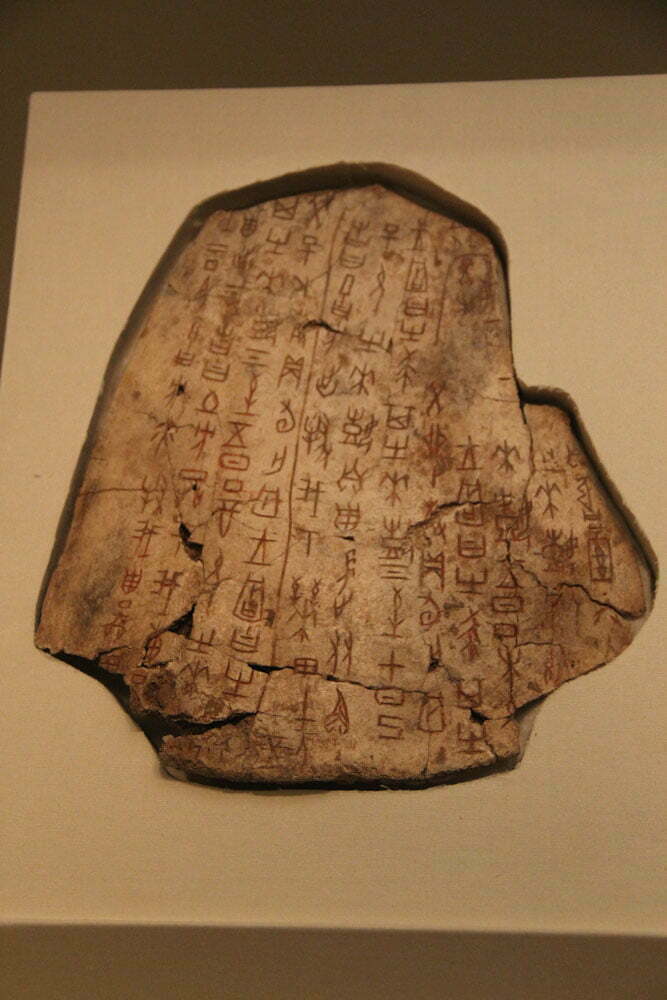
In that sense, the Chinese Language has encoded in writing a vast and rich repository of the Chinese Culture with the big ‘C’ – the part of culture which is more affiliated with the Arts, such as the “music, literature, painting and sculpture, theatre and film”, and may include “philosophy”, “scholarship” and “history” (Williams, 2015).
We know that the understanding and use of the any language can be deeply linked to the its target culture. Understanding the culture is crucial to grasping the nuances and subtleties of the language, including idioms, proverbs, and expressions that are deeply rooted in the culture. For Chinese Language, this challenge is made tougher when the culture is embedded with a long history of literary tradition alongside the daily elements we can observe and learn.
For example, in natural communication between native speakers, Chinese tend to use a large deal of idioms, proverbs, imagery, allusions, and other expressions that are referenced specifically to the culture. This is the case in both informal and formal contexts, and can also exist within the written mode.
Personally, I have easily encountered quite a number of quadrisyllabic idioms (the canonical type of idioms in Chinese) in academic articles. Occasionally, I have also heard cited lines from poems from the Tang and Song Dynasty during a commercial presentation. Such patterns of use are generally assumed to be felicitous among the Chinese.
In conclusion, to effectively use the Chinese Language, it is important to immerse oneself in the culture and understand its history, values, and beliefs. This is somewhat inevitable if we are to talk about mastery at higher levels, regardless of use in formal or informal contexts.
Get real-time updates and BE PART OF THE CONVERSATIONS by joining LEA’s online communities on your favourite platforms! Connect with like-minded language educators and get inspired for your next language lesson.
5. The syllable is usually the starting point for the analysis of pronunciation in a Chinese Language, including Mandarin.

Similar to all other human natural languages, syllables are constructed with both consonants and vowels in the Chinese Languages. However, in most other alphabetical languages like English, a syllable is generally an intermediate structure between a sound and a word.
For instance, a word such as “intermediate” has five syllables (in-ter-mee-dee-it) and every isolated syllable does not carry any meaning on its on – mere representation of a sound. With the exception of monosyllabic words (e.g. a, wet, cat), most syllables need to combine to become words.
In Chinese Languages, every syllable can potentially be a building unit of meaning and correspond to a morpheme. Of course, this is not to say that all morphemes are monosyllabic, but there are indeed a lot of monosyllabic morphemes. An example is “xiao3 hai2” (??), where the first syllable “xiao3” can denote the meaning of “young” and “small” while the second syllable “hai2” denotes the meaning of “child”).
In correspondence to writing, every syllable may correspond to a letter or a group of letters in alphabetical languages but will definitely correspond to only a Chinese character for Chinese Languages (one syllable to one Chinese character). While indeed there might be creative ways of merging characters into one to denote a word as illustrated in this article, a monosyllable will also be created for the newly created character.
6. In analysing a syllable, chinese linguists prefer the use of initials, finals and tones in the phonemic inventory for any Chinese Language, instead of consonants and vowels.
Analysis of Chinese words and syllables using consonants and vowels are means of aligning with international practices of phonetic and phonological analysis. In practice, Chinese linguists prefer the use of initials (??), finals (??) and tones (??) to make generalisations for Mandarin or other Chinese Languages.
We are probably not foreign to the concept that Chinese Languages are tonal languages. A pronunciation such as “ma” can be pitched differently, such as ma1, ma2, ma3, ma4, and ma. Note that I have used numbers instead of the convention used (e.g. m?) for ease of understanding. Different pitches denote a whole set of different possible meanings. The use of changes in pitch to distinguish word meanings is what is known to be “tone” in linguistics.
Considering the syllable to be starting point of analysis, at least phonologically, a structure of initials, finals and tones can thus be applied to almost all Chinese syllables. Taking Standard Mandarin as an example, the syllable structure is typically composed of an initial segmental consonant; a final which can comprise a medial, a nucleus and an ending; and a supra-segmental tone. The diagrams below thus show all the possible sounds that can go into Standard Mandarin:
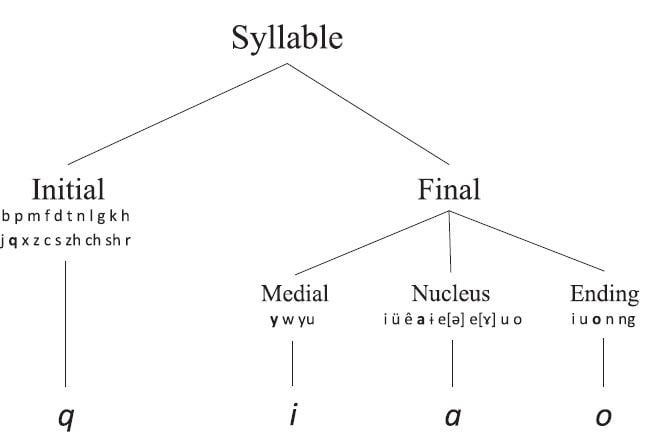
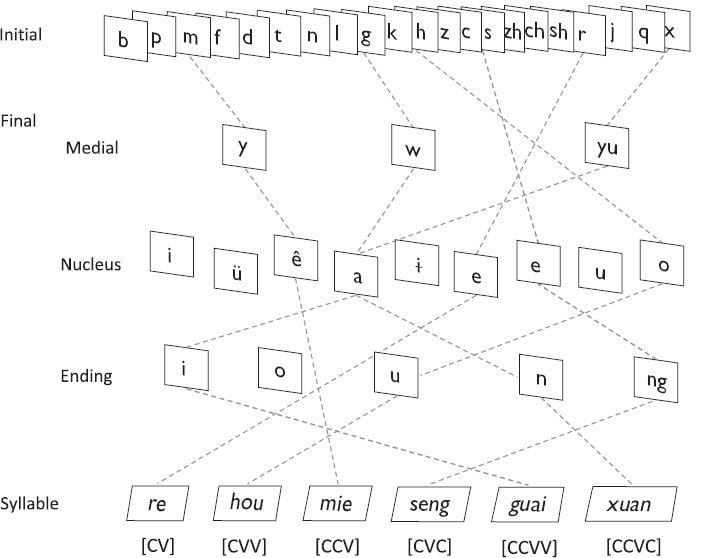
As such, if you are a language educator or learner dealing with the analysis of pronunciation in Mandarin, this might be the approach that you should be considering if you are not already adopting this. To a certain extent, cutting the knowledge of all the specifics that can go in, the simple structure allows the learners to know how to start the pronunciation of any syllable or Chinese character.
7. Particularly for the Chinese Language of Standard Mandarin, most words are monosyllabic and bisyllabic while containing one or two morphemes.

In linguistics, a “word” is defined as a “syntactically free form”, which is a unit that can fill up a syntactic slot independently according to the rules and norms of the syntax in the language.
Based on this understanding, most words are bisyllabic (71%) and monosyllabic (26%) in Standard Mandarin (Lu, 2004). Polysyllabic words occupy only about 3% of the inventory (i.e. very rare). Note that this refers to words, and not lexical units (where some linguists can view an idiom as a unit – many Chinese idioms are quadrisyllabic).
We have established earlier that a syllable can largely correspond to a single morpheme rather frequently in Standard Mandarin. As such, it is unsurprising that most words in Standard Mandarin consist of either one or two morphemes.
Noting this feature, learners can expect to be learning and processing a large number of monosyllabic and bisyllabic words on a regular basis. When placed in a sentence, you can also imagine the rhythm of the sentence (where some non-native speakers may describe as a musical accent) packed with predominantly bisyllabic units and a whole other group of monosyllabic units.
8. Homophony is a common phenomenon in Mandarin.

This is definitely one characteristic that perplexes many learners of Mandarin (and quite some other Chinese Languages) as a second/foreign language. Homophony refers to the linguistic phenomenon where words of different origins evolve eventually to adopt similar pronunciation. Homophones, referring to the words in such phenomena, can sometimes cause semantic ambiguity without further contextual information. For instance, if I just say “I am at the bank” without further elaboration, my interlocutor may not be able to tell whether I am at a financial institution or near the river.
Mandarin consists of around 400 phonetic syllables in total, and this limited inventory inevitably lead to many syllables to denote similar words. On average, the degree of homophones in Chinese is 7.85 – very high (Wang & Tsai, 2015). In writing, disambiguation is easy since the characters differ in forms: a syllable pronounced as “bù” can refer to the following characters (not exhaustive) of “?”, “?”, “?”, “?”, “?”, etc.
In fact, it is completely possible to produce a complete written work in the Chinese Language (classical Chinese though) using many homophones. One of the most famous attempts was by the Chinese linguist Yuen Ren Chao who deliberately composed the narrative poem “Lion-Eating Poet in the Stone Den” (Chinese: ?????; pinyin: shi1 shi4 shi2 shi1 shi3) in the 1930s:
“?????????????????????????????????????????????????????????????????????????????????????????????????????????????????????”
In spoken form, particularly Mandarin, the poem is incomprehensible even for native speakers: you will just hear a lot of “shi” in different tones – basically just 4 types of syllables. In written form, however, if you have some training in reading classical Chinese, it can be interpreted.
The large number of homophones in Mandarin (and in any other Chinese Language) thus paves the way for the frequent use of homophonic puns. For example, during the Lunisolar New Year (or more commonly known by its misnomer “Lunar New Year”), fish is a common dish that is served or appears in artwork as part of decorations on the wall because the pronunciation of “fish” (? yu2) is similar to a word that signifies “abundance” (? yu2).
Homophony in Mandarin (or in any other Chinese Language) can be a major source of difficulty for many learners, since puns are so popular in contemporary use. If learners seek to read literary works, the interpretation of homophones is also necessary to allow a deeper appreciation of certain cultural references made through such words.
9. Mandarin (or any Chinese Language) lacks inflectional properties – but there is inflection.
In linguistics, inflection refers to the phenomenon where the form of a word is modified to reflect changes in the grammatical function or category, to express syntactic meaning such as tense, case, aspect, gender, etc.
In most languages with typical inflectional properties, we can observe most of such phenomena with nouns, verbs and adjectives in general. The words take different forms when they are performing different grammatical functions, even when the root meaning is similar. Inflectional variants can be overt or covert in manifestation.
Taking English as an example, “play” as a verb has several inflectional forms “playing”, “player”, “played”, “replay” and “plays”. These are overt variants, since we can observe the explicit concatenation of an affix to the root word “play” in the different variants.
Covert forms require more analysis. For example, “he”, “she”, “it”, “they” are various means to express gender, animacy and number for selected people or objects in reality. In such cases, we know they are variants of one another to be used under different contexts according to the criteria.
Many people like to exaggerate that Mandarin (or any Chinese Language) is completely free of inflection. That is not completely true, and a more precise description would be Mandarin lacks inflectional properties. For one, covert forms do exist. For example, the singular third-party pronouns like “he”, “she” and “it” do have corresponding buddies in Mandarin though all are homophones – all pronounced as ta1 (? he, ? she, and ? it).
Are there overt forms of inflection in Mandarin? Arguably yes but limited. This particularly refers to possible affixes that are bound and functional morphemes. There are two main types of such affixes: derivational affix and inflectional affix (Packard, 2015). The derivational affix, when concatenated with another morpheme (regardless of free or bound), will create a new word with a different grammatical form.
For example, a common derivational affix is “-hua ?” and can turn words such as “??” (ren2 xing4, meaning “human nature” or “humanity”) to “???” (ren2 xing4 hua4, meaning “humanise”); and “??” (ke1 xue2, meaning “science”) to “???” (ke1 xue2 hua4, meaning “made scientific”). In other words, it transforms the original morpheme/word into a verb.
The inflectional affix, in contrast, can only be attached to words (free morphemes). They do not transform the grammatical category of the word and only add a meaning minimally. A classic example is ? (men2) which is positioned following nouns or pronouns as a suffix to express a plural form, such as “??” (wo3 men, we), “??” (ta1 men, they) and “???” (hai2 zi men, children).
10. Segmentation of words and parts of speech can be challenging in a Chinese Language, whether spoken or written.

We know that every syllable in a Chinese Language, such as Mandarin, can potentially be a morpheme and a single unit of meaning. They can team up with other morphemes to become new words or be realised as a word individually (i.e. free morphemes in contrast to bound morphemes). While the majority of Chinese words are bisyllabic, we also understand that there is still a critical mass of words which are monosyllabic. Furthermore, low proportion does not equate to zero existence – polysyllabic words exist too.
As such, every syllable that you hear or see (thus every written/printed Chinese character) can potentially be simply a morpheme of another word, or is a word itself. For spoken language, the challenge is made complicated with the existence of homophones. As a learner listens to a string of syllables, he/she needs to decode what every syllable might refer to, based on his/her current mental lexicon.
For the written language, space is a good approximation for word segmentation in modern alphabetical langauges. The overt features that come alongside inflectional properties will also not complicate such a recognition. Assuming the following string of pseudo-words are actually an English sentence, “bz bjdg imghing faggg sxrduly”, you can tell by spaces that there are 5 words – you might even guess that the third word is the present tense of a verb and the last word might possibly be an adjective.
In Mandarin, spaces are not put in place between words. For example, can you tell how many words are there in this sentence “????????????”? There are a total of 12 syllables if the sentence is read aloud, and thus a total of 12 chinese characters. Where are the morphemes, words, or any particular part of speech?
While we can leverage the knowledge that most Chinese words are monosyllabic and bisyllabic to help us analyse, but we can hardly be as confident as the judgement in alphabetical languages.
11. The syntactic structures of parts of speech in a Chinese Language is rather consistent, BUT many parts of speech can be omitted when the context allows it.

In terms of syntactic analysis, once a learner passes the word segmentation test as presented earlier, the structure of a part of speech is quite consistent Mandarin (and any other Chinese Language) that thus makes it easier to identify certain grammatical functions.
In this sense, with Mandarin as an example, the positions of specific syntactic units are quite consistent. For example, in a noun phrase, the modifiers of the noun always precede the noun – if you observe modifier-lookalikes after the noun, they are not part of the noun phrase in question and should be analysed as a subject-predicate or topic-comment. Likewise, in a verb phrase, if the modifier of the verb precedes the verb, it belongs to one group of verb phrases; if the modifier follows the verb or alongside some particles, it belongs to another group of verb phrases.
Notwithstanding that, the tricky part comes when omission occurs. We know that the subjects and objects cannot be easily omitted from English (e.g. the sentence becomes ungrammatical) even when the context allows for it (e.g. response to a question).
For a Chinese Language, many parts of speech, sometimes even the functional words, can be omitted within a Chinese sentence when given enough context and it remains grammatical. The illustrative examples as follows:
- Do you drink ten glasses of water every day? (????????)
- Yes, I drink ten glasses of water every day. (??????????)
- *Yes, I ten glasses of water every day. (?????????)
- *Yes, drink ten glasses of water every day. (?????????)
- *Yes, drink every day. (??????)
- Where are you going tomorrow? (???????)
- I am going to Canada tomorrow. (????????)
- *Going to Canada tomorrow. (???????)
- *Going to Canada. (?????)
While the examples given suggest that such a phenomenon only exists after a question, the practice of omission is actually quite pervasive in pragmatic use, since the communicative context usually provides many contextual clues. This means that any learner may encounter a myriad of such constructions, in speech or in writing, and should always be prepared to take reference from the holistic context in decoding the Chinese Language input.
12. The word order in Mandarin (or any other Chinese Language) can be quite flexible, although the topic-prominent structures in syntax can help us decipher the meaning of the sentence.

Similar to English, the canonical word order of Mandarin is Subject-Verb-Object (SVO). Most of the beginning sentences may appear in such a structure. However, in organic use among proficient and native speakers, the word order can be very flexible – with further complications from the optional omission stated earlier.
For example, a sentence completely made up by nouns and devoid of verbs is completely possible: *Tomorrow afternoon airport main entrance. (?????????). This can be an instruction in the meeting time and venue between two persons, or a clarification to when and where an event (e.g. maintenance and servicing) is taking place, or many more other possible contexts that I shall not outline here. In that sense, there are more than one subject in the statement.
Another example with a few variations of similar meanings:
- I have said I am not eating the chicken meat. (?????????)
- *The chicken meat I have said I am not eating. (?????????)
- * I have said the chicken meat I am not eating. (?????????)
- * I have said not eating the chicken meat. (????????)
- * I have said the chicken meat not eating. (????????)
A slight mitigation in parsing Mandarin sentences, especially for learners who may just be encoding to understand the meaning, is to understand the topic-comment structures. This is linguists may call “topic prominence”. This means that the subject of the sentence usually functions as the topic of focus which appears at the beginning of clauses before any information about them. In a way, such a structure allows speakers/writers to emphasise whatever aspect of their statement they deem important.
One of the key characteristics of such languages, including Mandarin (or any other Chinese Language) is that the subject and object are not explicitly marked. In some cases, as I have demonstrated earlier, there may be more than one subject. As such, learners who are not used to parsing such sentences may find some difficulty in doing so.
However, with the notion of topic-comment structures, this is where learners can start. By identifying the topic in salience, the learner can then proceed to process what is possibly the comment about the topic – an elaboration about the topic. For instance, the topic in the sentence “*Tomorrow afternoon airport main entrance. (?????????)” is the time “tomorrow afternoon” with the comment of “airport main entrance”. Piecing both together, with further contextual clues, the learner then makes a deduction on what the sentence is about.
13. A classifier system exists within Chinese Languages and it requires much exposure to really grasp it clearly.

The use of classifiers is systematic in Mandarin (and any other Chinese Language) and is considered a unique feature of the language(s). A classifier is a word or affix that is attached to a noun (e.g. precedes the noun) and is usually used to stipulate the semantic class of the noun.
Mandarin (and any other Chinese Language) has an extensive system of classifiers for nouns, in which a classifier must be included in a noun phrase that possess characteristics of referentiality and enumeration. For instance, we can say “this apple”, “that apple”, “one apple”, “two apples” in English without having to insert a word or particle between the pronoun (“this”, “that”) or number (“one”, “two”) and the noun “apple”.
In Mandarin, however, we cannot directly express the same phrase in the same manner. To express similar phrases, we need to include a classifier such as “?” between the determiner and the noun “apple” to become “????” (“this ke1 apple”), “????” (“that ke1 apple”), “????” (“one ke1 apple”), and “????” (“two ke1 apples”).
In English, we also have expressions such as “a bundle of apples” or “that box of apples”. Indeed, some linguists have termed these “numeral classifiers” though they are more commonly known as “measure words” – words (or morphemes) that are used in combination with numerals and are used to specify the type or quantity of nouns being referred to.
Measure words are used in English under the same definition to convey information about the size or amount of the object(s) (i.e. a unit of measurement) being referred to. They are typically used with mass or uncountable nouns (e.g. a pail of water, three drops of mud), but can also be used with countable nouns (e.g. a box of apples, three trucks of bricks). There is no strict collocation of a particular measure word to selected nouns.
For example, the measure word “box” can be used with different nouns: a box of apples, a box of bricks, a box of computers, etc. Similarly, the measure word used for a particular noun can also vary depending on the intended unit of measurement: a box of apples, a pail of apples, a truck of apples, etc.
In the same manner, such expressions and the corresponding measure words can also be found in Mandarin. In the case of one measure word to different nouns, the examples are: a box of apples (????), a box of bricks (????), a box of computers (????). In the case of different measure words to a particular noun, the examples are: a box of apples (????), a pail of apples (????), a truck of apples (????).
The main difference in the classifier system in Mandarin, is that there is an additional group of “sortal classifiers” which can be much more selective (Ahrens & Huang, 2016). They are more typical as classifiers in Chinese, where choices of the exact classifier are tied to the inherent properties of the noun to be referred to. Such choices can be conceptually salient and intuitive, such as “?” (zhi1) selects animals, whereas “?” (zhang1) selects thin, broad objects (e.g paper ???). Any particular choice is based on one’s general knowledge and experience, as well as with the intricacies of Mandarin.
14. Sentence-final particles exist in Mandarin (or any Chinese Language) to express various meanings.

Another interesting feature found in Mandarin (or any Chinese Language) is the prevalent use of sentence-final particles usually within the spoken language and informal writing (e.g. text messaging, posting on social media). In general, sentence-final particles in Mandarin are small, unstressed words or syllables that are added to the end of a sentence to express the speaker’s attitude, tone, or intention – a discourse marker. They convey nuances of meaning that are not expressed through the lexical and structural meaning expressed in the sentence.
Similar to classifiers, the system of sentence-final particles can also be complicated and requires a more thorough thesis to represent. Below are just some typical examples to illustrate how some of such common particles work:
- The particle “?” (ba) can be added to the end of a declarative sentence to make it more forceful or persuasive.
- The particle “?” (le) can be used to mark a statement as relevant to the current communicative context.
- The particle “?” (ne) can be used to indicate a questioning tone or to seek agreement or confirmation.
- The particle “?” (a) can be used to soften the tone of a sentence and express a more tentative attitude.
Note that these are not the only functions of these particles, and there a dozen or more other particles. As discourse markers, sentence-final particles can assist in organising ideas, soliciting information, offering suggestions, providing evaluations, issuing warnings, expressing emotions, seeking agreement, building alliances, closing conversations, etc (Shei, 2014).
Certain pragmatic functions are enhanced or accentuated with sentence-final particles, such as warning with “?” or providing a reason with “?”. Other sentence-final particles are only marginally needed to perform the function associated with the whole utterance, such as “?” used redundantly to form a question or “?” used to emphasise a statement.
In summary, sentence-final particles are characrteristic of Mandarin. They complement the structural grammar rules to create a language that is more nuanced and adaptable.
15. The writing system of Chinese poses challenges for reading, though there is a pseudo-writing system which aids reading (and pronunciation for second language learners).
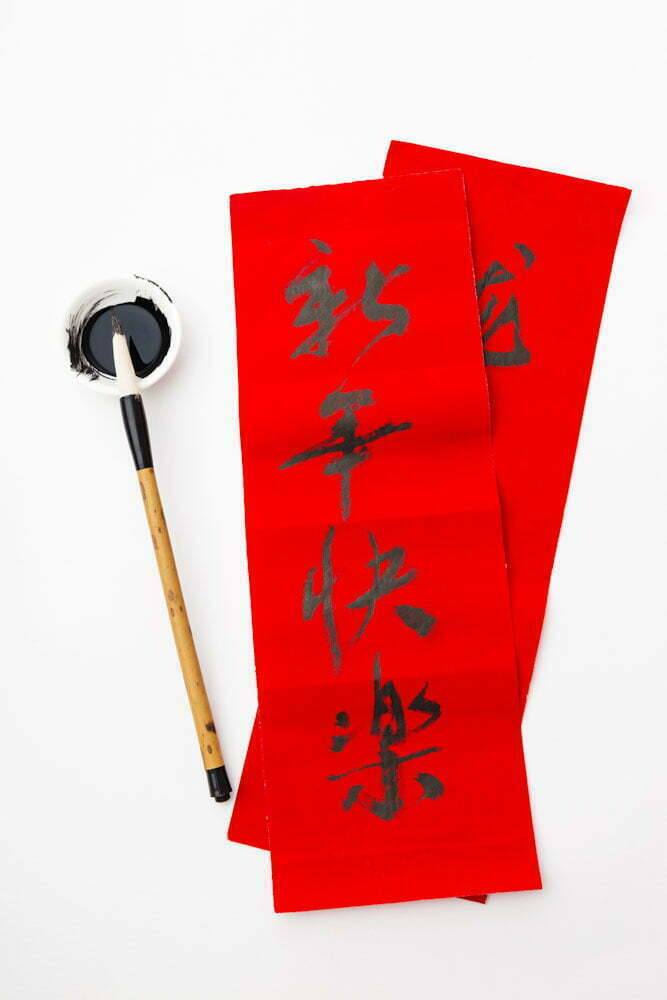
Many learners of Mandarin have particularly shared on the pains of reading acquisition. Indeed, not all languages are made equal when it comes to reading (and reading instruction), and Mandarin is one language which is at the extreme end of a spectrum.
According to the Science of Reading, reading comprehension is fundamentally made up of two components: “decoding” and “linguistic comprehension”; and the routes between both has been understood to be limited to two pathways: the phonologically mediated pathway (e.g. grapheme-sound-meaning) and the more direct semantic pathway (e.g. grapheme- meaning). These findings hold regardless of languages.
However, there are certain languages that lend themselves quicker for reading acquisition, notably because of the writing systems adopted. Scholars who studied writing systems have coined a concept – transparency – of writing systems.
Transparent languages refer to those which writing systems comprise simple rules governing spelling-to-sound (e.g. German, Italian, Spanish). In such languages, letter-to-sound conversion rules are relatively simple where every distinctive grapheme represent a distinctive phoneme with little exceptions.
Opaque languages, on the other hand, are less straightforward. Every letter in the alphabet may represent a range of phonemes – or what we usually describe as “phonetically inconsistent” (e.g. English, French). At the extreme end of opaque languages are languages which use logograms – including Mandarin (or any Chinese Language).
In Mandarin, readers must memorise a large number of characters. For instance, around 4,000 are necessary for daily casual reading, around 7000 are required for slightly more complicated everyday reading in Chinese and up to 40,000 are used in literary and specialised texts. Note that learners who learn Mandarin in Taiwan and Hong Kong have to manage the traditional writing system, while those learning in Mainland China, Singapore and Malaysia use the simplified writing system.
Despite the inherent challenge in reading acquisition, there is a pseudo-writing system that the Chinese have created in the 1950s that can offer instrumental interim support for learners. The system is more commonly known as the romanisation system of Mandarin aka the “Hanyu Pinyin” system (or “Pinyin” for short). Pinyin transcribes the sounds of Mandarin. It is used primarily for teaching and learning the pronunciation of Chinese characters, and is also used as an input method for computers and other electronic devices.
Pinyin was developed in conjunction with simplified Chinese characters to increase the literacy rate of Chinese and promote the use of Mandarin as the official language of China. As Pinyin provides the phonetical transcription of Mandarin words, it became an important tool for supporting early readers who have relatively good exposure of the spoken language.
Join our mailing list!
Receive insights and EXCLUSIVE resources on language education in a monthly newsletter, fresh into your inbox. No Fees, No Spam, so No Worries!
Conclusion and Recommended Books
In conclusion, the Chinese Language (or better known as Chinese Languages) is a complex yet fascinating language family. Particularly with Mandarin as the main example, it has an array of interesting features that we should take note if we are to learn it. Of course, this article is merely around 7 thousand words and condensing the fascinating features of a language family with a history of more than 4 thousand years is just not the simplest task.
As the Chinese saying goes: “A journey of a thousand miles begins with a single step”. This applies to language learning too –– especially for a language such as Mandarin. With perseverance, patience and dedication anyone can unlock the secrets of this beautiful language which will undoubtedly bring them immense joy along the way.
Thank you for reading! If you like what you are reading, do subscribe to our mailing list to receive updated resources and tips for language educators. Please also feel free to provide us any feedback or suggestions on content that you would like covered.
References
Ahrens, K., & Huang, C. (2016). Classifiers. In Huang, C., & Shi, D. (Eds.), A Reference Grammar of Chinese ?????? (pp. 169-198). Cambridge UK: Cambridge University Press.
Chen, P. (1999). Modern Chinese: History and Sociolinguistics. New York USA: Cambridge University Press.
Chen, P. (2015). Language Reform in Modern China. In Wang, W.S., and Sun, C. (Eds.), The Oxford Handbook of Chinese Linguistics. New York USA: Oxford University Press. DOI: 10.1093/oxfordhb/9780199856336.013.0034.
Dehaene, S. (2009). Reading in the Brain: The Science and Evolution of a Human Invention. New York USA: Viking (Penguin Group).
Handel, Z. (2015). The Classification of Chinese: Sinitic (The Chinese Language Family). In Wang, W.S., and Sun, C. (Eds.), The Oxford Handbook of Chinese Linguistics. New York USA: Oxford University Press. DOI: 10.1093/oxfordhb/9780199856336.013.0001.
Ho, D. (2015). Chinese Dialects. In Wang, W.S., and Sun, C. (Eds.), The Oxford Handbook of Chinese Linguistics. New York USA: Oxford University Press. DOI: 10.1093/oxfordhb/9780199856336.013.0002.
Huang, C., & Hsieh, S. (2015). Chinese Lexical Semantics: From Radicals to Event Structure. In Wang, W.S., and Sun, C. (Eds.), The Oxford Handbook of Chinese Linguistics. New York USA: Oxford University Press. DOI: 10.1093/oxfordhb/9780199856336.013.0018.
Huang, C., & Shi, D. (2016). Preliminaries. In Huang, C., & Shi, D. (Eds.), A Reference Grammar of Chinese ?????? (pp. 1-14). Cambridge UK: Cambridge University Press.
Liu, M. (2015). Tense and Aspect in Mandarin Chinese. In Wang, W.S., and Sun, C. (Eds.), The Oxford Handbook of Chinese Linguistics. New York USA: Oxford University Press. DOI: 10.1093/oxfordhb/9780199856336.013.0070.
Lu, J.M. ????2004?????????????????????????
Lu, J.M. ????2019????????????????????
Lu, J.M., & Ma, Z. ???????2016???????????????????????????????
Lu, J.M., & Shen, Y. ???????2004?????????????????????????
Packard, J. (2015). Morphology: Morphemes in Chinese. In Wang, W.S., and Sun, C. (Eds.), The Oxford Handbook of Chinese Linguistics. New York USA: Oxford University Press. DOI: 10.1093/oxfordhb/9780199856336.013.0045.
Packard, J. (2016). Lexical word formation. In Huang, C., & Shi, D. (Eds.), A Reference Grammar of Chinese ?????? (pp. 67-80). Cambridge UK: Cambridge University Press.
Ross, C., & Ma, J.S. (2006). Modern Mandarin Chinese Grammar: A Practical Guide. Abingdon UK: Routledge.
Shei, C. (2014). Understanding the Chinese Language: A comprehensive linguistic introduction. Abingdon UK: Routledge.
Shi, D., & Huang, C. (2016). Syntactic overview. In Huang, C., & Shi, D. (Eds.), A Reference Grammar of Chinese ?????? (pp. 14-66). Cambridge UK: Cambridge University Press.
Sun, C. (2009). Chinese: A Linguistic Introduction. New York USA: Cambridge University Press.
Tao, H. (2015). Profiling the Mandarin Spoken Vocabulary Based on Corpora. In Wang, W.S., and Sun, C. (Eds.), The Oxford Handbook of Chinese Linguistics. New York USA: Oxford University Press. DOI: 10.1093/oxfordhb/9780199856336.013.0031.
Teaching and Research Centre for the Chinese Language (Peking University). ???????????????2003????????????????????
Teng, W. (2014). Yufa! A Practical Guide to Mandarin Chinese Grammar. Abingdon UK: Hodder Education.
Wang, F., & Tsai, Y. (2015). Chinese Writing and Literacy. In Wang, W.S., and Sun, C. (Eds.), The Oxford Handbook of Chinese Linguistics. New York USA: Oxford University Press. DOI: 10.1093/oxfordhb/9780199856336.013.0051.
Williams, R. (2015). Keywords: A Vocabulary of Culture and Society. New York USA: Oxford University Press.
Wu, F., & He, Y. (2015). Some Typological Characteristics of Mandarin Chinese Syntax. In Wang, W.S., and Sun, C. (Eds.), The Oxford Handbook of Chinese Linguistics. New York USA: Oxford University Press. DOI: 10.1093/oxfordhb/9780199856336.013.0020.
Xu, Y. (2015). Intonation in Chinese. In Wang, W.S., and Sun, C. (Eds.), The Oxford Handbook of Chinese Linguistics. New York USA: Oxford University Press. DOI: 10.1093/oxfordhb/9780199856336.013.0012.
Zhu, X., & Wang, C. (2015). Tone. In Wang, W.S., and Sun, C. (Eds.), The Oxford Handbook of Chinese Linguistics. New York USA: Oxford University Press. DOI: 10.1093/oxfordhb/9780199856336.013.0011.
